Testifire vs Solo: Which Fire Alarm Testing Kit Is Right for You?
Choosing between Solo and Testifire is one of the most common decisions UK fire alarm engineers face when investing in professional detector testing equipment.
Both systems are trusted across the industry and suitable for testing in accordance with BS 5839. However, they are designed with different priorities in mind.
This in-depth comparison of Solo vs Testifire breaks down the practical differences, including the newer Testifire XTR2 so you can decide which system best fits your workload, site size, and servicing model.
Understanding the Core Difference
At a high level:
-
Solo Range is modular and flexible
-
Testifire Range is integrated and efficiency-focused
- Testifire XTR2 range – advanced all-in-one smoke and heat testing
The Solo Approach: Modular, Proven, Cost-Effective
The Solo range has been widely used by UK engineers for decades. Its system is modular, meaning separate tools are used for:
-
CO detector testing - this would be used with the same solo 330 smoke head, but using the CO2 spray.
Engineers can build a kit around their specific needs rather than investing in an all-in-one unit.
Why engineers choose Solo:
-
Lower upfront cost
-
Lightweight equipment
-
Easy replacement of individual components
-
Straightforward maintenance
Models such as the Solo 823 and Solo 814 remain extremely popular for routine maintenance contracts and smaller commercial sites.
Solo is often preferred by engineers servicing:
-
Schools
-
Care homes
-
Small office buildings
-
Residential blocks
Where testing volume is steady but not excessive.
The Testifire Approach: Integrated and Efficient
Testifire takes a different approach. Instead of modular heads, it integrates smoke, heat, and CO testing into one unit.
This eliminates the need to swap heads while moving between detector types — a significant advantage on larger sites.
Traditional Testifire Models (1000 & 2000 Series)
Earlier Testifire models such as the 1000 and 2000 series introduced capsule-based smoke testing and built-in heat generation in a single device.
Benefits include:
-
Faster workflow
-
Reduced equipment changes
-
Cleaner testing compared to aerosols
- Capsule testing in replacement of testing cans
These models are commonly used on:
-
Multi-storey commercial buildings
-
Hospitals
-
Industrial units
-
Large office complexes
It’s worth noting that the Testifire 2000 remains available and is widely used for combined smoke, heat and CO detector testing.
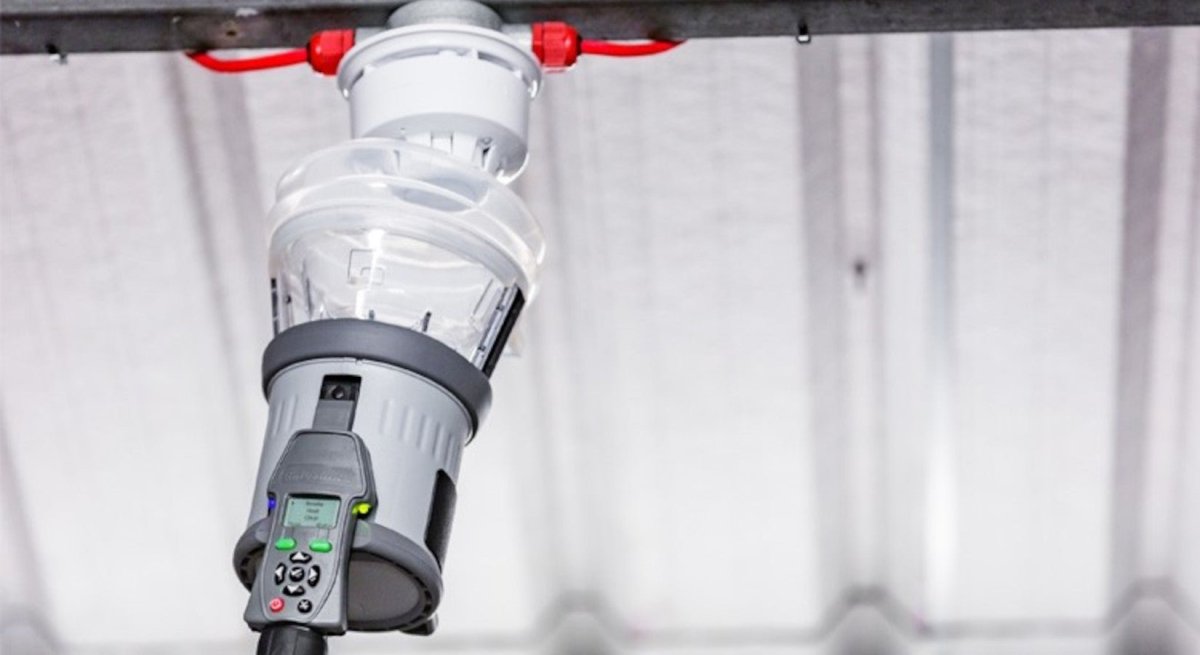
However, the original Testifire 1000 model has now been discontinued and replaced by the newer Testifire XTR2. The XTR2 builds on the all-in-one design of the earlier 1000 series, offering improved performance, durability and efficiency for modern servicing requirements.
Introducing the Testifire XTR2
The Testifire XTR2 builds on the original all-in-one concept and adds enhanced performance and durability.
Key advantages of the XTR2 include:
-
Faster activation times
-
Improved battery performance
-
Robust design for high-frequency testing
-
Integrated smoke, heat and CO capability
-
Capsule-based smoke system
- Includes access to the XTR2 Portal, allowing easy firmware updates, performance monitoring and enhanced device management
The XTR2 is designed for engineers who carry out large volumes of detector testing and need reliability across demanding service schedules.
Compared to modular systems, the XTR2 reduces:
-
Manual handling
-
Equipment switching
-
Downtime during testing
For contractors managing national service contracts or high-density commercial sites, the XTR2 can offer measurable efficiency improvements over modular systems.
It is important to note that the Testifire XTR2 currently provides smoke and heat detector testing only and does not support CO testing at this time. Engineers requiring combined smoke, heat and CO capability should consider the Testifire 2000 model, which continues to offer integrated CO testing functionality.
Solo vs Testifire: Side-by-Side Comparison
| Feature | Solo | Testifire (1000/2000) | Testifire XTR2 |
|---|---|---|---|
| Testing method | Modular heads | All-in-one | Advanced all-in-one |
| Smoke testing | Aerosol-based | Capsule-based | Capsule-based |
| Heat testing | Separate heat tool | Integrated | Integrated |
| CO testing | Separate head | Integrated on the 2000 | No |
| Speed on large sites | Moderate | Fast | Faster |
| Upfront cost | Lower | Higher | Higher |
| Best suited for | Small–mid sites | Large sites | High-volume commercial |
Compliance and UK Standards
All systems discussed — Solo, Testifire 1000/2000, and Testifire XTR2 — are suitable for professional fire alarm testing in line with:
-
Manufacturer-approved testing procedures
-
Routine inspection requirements
Your choice does not affect compliance — it affects efficiency and workflow.
When Solo Makes More Sense
Solo is often the right choice if:
-
You want lower initial investment
-
You primarily service smaller sites
-
You prefer modular flexibility
-
You don’t regularly switch between detector types
Its simplicity and reliability make it ideal for engineers who value straightforward equipment without advanced integration.
When Testifire (Including XTR2) Makes More Sense
Testifire — particularly the XTR2 — may be better suited if:
-
You service large commercial buildings
-
You test high volumes of detectors daily
-
Efficiency is critical to profitability
-
You want fewer equipment changes during servicing
The all-in-one design can reduce time per detector, which becomes significant on contracts involving hundreds of devices.
Cost Considerations: Short-Term vs Long-Term
Solo
-
Lower purchase price
-
Modular replacements
-
Ongoing aerosol usage
Testifire / XTR2
-
Higher upfront investment
-
Capsule-based smoke system
-
Time savings on larger systems
-
Potential long-term productivity gains
The right decision depends on the scale and frequency of your servicing contracts.
Which Detector Tester Is Better?
There isn’t a universal “best” option.
The better system depends on:
-
Site size
-
Detector volume
-
Budget
-
Working style
For smaller maintenance contracts, Solo remains a dependable and economical solution.
For larger commercial servicing, Testifire — especially the XTR2 — offers a streamlined, high-efficiency approach.
Final Verdict: Solo vs Testifire
Choose Solo if:
-
You want modular flexibility
-
You service smaller sites
-
Budget is a key factor
Choose Testifire 2000 if:
-
You want integrated testing
-
You work on medium to large sites
- Want CO2 testing intergrated
Choose Testifire XTR2 if:
-
You manage high-volume commercial contracts
-
Speed and durability are priorities
-
You want the most advanced all-in-one option